
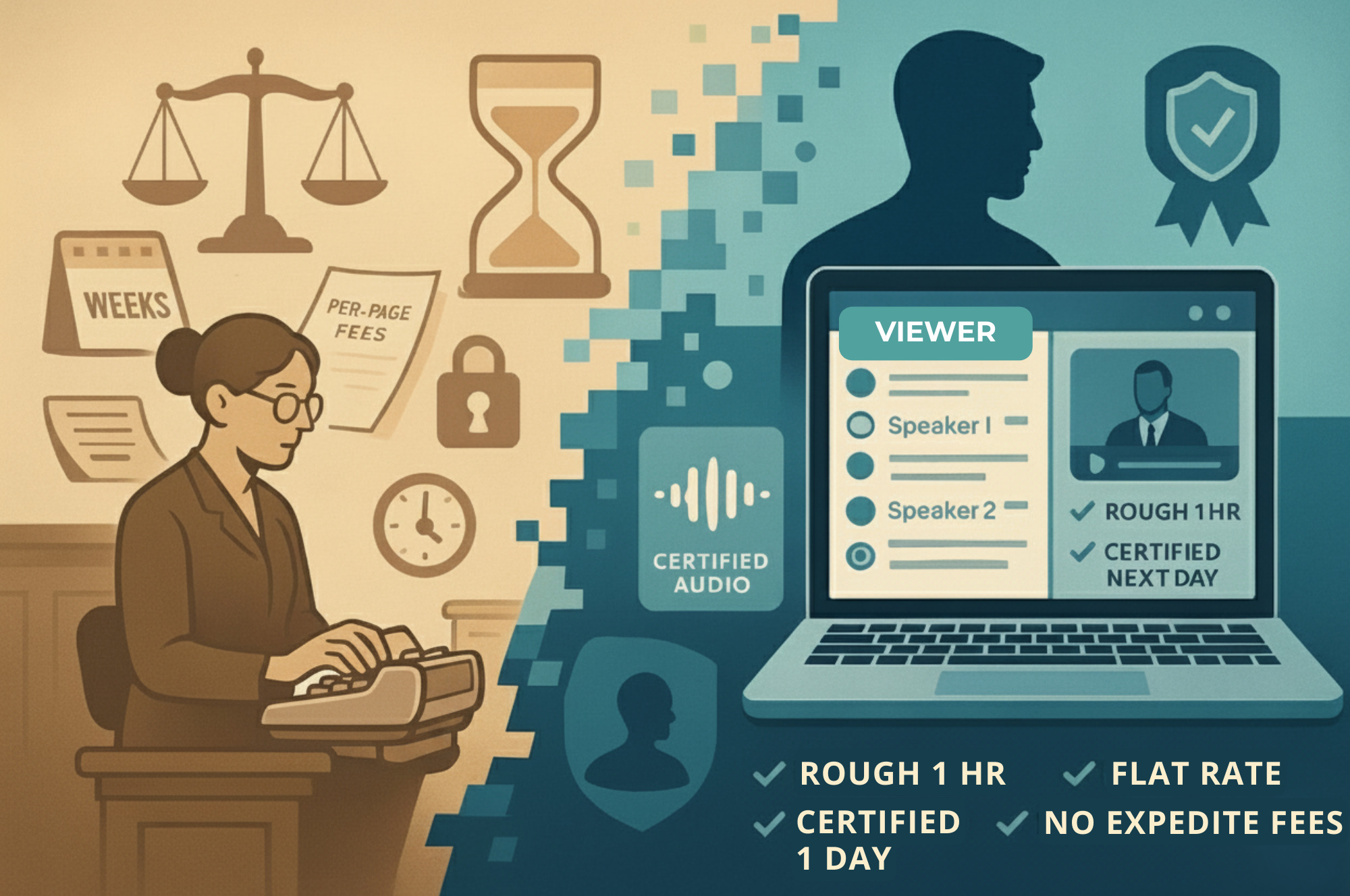
Court reporting may be one of the last strongholds of pre-digital process in the legal world. For decades, realtime reporting has meant one thing: a stenographer with a proprietary machine, often charging by the page, and producing a transcript at a pace that hasn’t materially changed since the 1980s.
When litigators think of legacy realtime court reporting, they think not only of the live feed of the transcript, but also the rough draft that follows and often, the expedited transcript too. This “realtime bundle,” if you will, has long been marketed as the gold standard, but it’s one that only firms with deep pockets or clients with deep pockets could afford. Add-on charges for roughs, expedited delivery of final transcripts, and realtime access turn this bundle into an exclusive tier of service, effectively out of reach for most attorneys and their clients.
But as with so many industries, from banking to travel to healthcare, technology has finally arrived at court reporting’s doorstep. The result is what we at Readback call the “New Realtime.”
The Paradigm Shift: Tech vs. Tradition
At its core, this is a classic story of innovation vs incumbency. The legacy players in this case, the stenographic lobby, have argued narrow interpretations for antiquated rules and laws that have yet to account for modern technology, customs, and practices. They’ve done this in the name of consumer protection, but often, it serves as a means of locking out faster, more affordable alternatives. Consider Family Violence Appellate Project et al. v. Superior Courts, Case No. S288176 (Cal. 2025), a petition before the California Supreme Court, which seeks to expand access to electronic court recording transcripts despite current law that continues to restrict access to a select category of cases as the state experiences a documented court reporter shortage. Relatedly, California Code of Civil Procedure, Section 2025.510(g), designates the stenographic transcript as the official record when a proceeding is captured by both stenographic and audio or visual means, a rule that features stenography in a manner similar to other states. See also Mass.R.Civ.P. 30(b)(3)(B) (requiring a stenographic record unless stipulated otherwise). Depending on the circumstances, such rules and laws may render modern methods like Active Reporting usable only by stipulation, court order, or perhaps unusable altogether.
This isn’t the first time an industry tried to protect its turf through regulation rather than innovation. Consider these examples:
- Taxi Medallions vs. Ride-Sharing: Taxis controlled urban transportation for decades through artificial scarcity (medallions). Then Uber and Lyft redefined how people move, using technology to reduce friction, increase accountability, and slash costs.
- Print Journalism vs. Digital Media: Traditional newspapers once claimed digital platforms lacked standards. But today, readers turn to fast, accurate digital outlets that use analytics and user data to improve trust and delivery.
- Landline Phones vs. Mobile Networks: Telecoms argued mobile was unreliable. Fast-forward, and wireless carriers now dominate communications, offering better service, speed, and scalability.
In every case, the market found its way to a better user experience. Technology didn’t just win, it made services faster, more responsive, and more affordable.
The Steno Stronghold and Its Cracks
Organizations like the National Court Reporters Association (NCRA) often frame non-steno solutions as risky. But let’s be honest, many of these arguments boil down to market protectionism. Meanwhile, attorneys across the country are frustrated with rising transcript costs, slow delivery, and inconsistent quality.
At Readback, we believe it’s time for court reporting to evolve.
Enter Readback’s Active Reporting: The New Realtime
Active Reporting doesn’t just challenge the old guard, it redefines what realtime can and should be.
For attorneys, the record isn’t just notes, it’s the backbone of strategy. Yet in traditional realtime, the “standard” is only 96% accuracy, the score reporters must hit on a certification test. After that exam, no one is verifying their live output. In practice, attorneys can be left with unverified, error-prone text presented as realtime. A single misstep in the transcript can change meaning and put your deposition at risk.
Active Reporting fixes this. By combining advanced speech-to-text with trained human editors, it delivers near-instant text that consistently exceeds industry accuracy. Attorneys can make decisions in the moment knowing the record is both immediate and dependable.
Why it matters: With Active Reporting, you don’t have to choose between speed and accuracy. You get both, which is exactly what high-stakes litigation demands.
But what truly elevates this process is the Guardian, a skilled professional who monitors the deposition, manages exhibits, ensures accuracy, and personally certifies the final transcript. The Guardian adds a layer of quality control, accountability and support of the deposition which surpasses traditional realtime. This personal touch is what makes Active Reporting not just a new version of realtime, it makes it a more comprehensive version.
Even more revolutionary is the transparency. Readback offers certified† on-the-record audio as part of the official proceeding record. Compare this with legacy realtime providers who often refuse to release audio, citing it as proprietary work product.
And it doesn’t stop there:
- Rough drafts are delivered within one hour of deposition close.
- Certified† transcripts are delivered by the next day.
- Flat-rate pricing eliminates surprises. No per-page fees, no expedite charges, no added costs for realtime access.
This is not incremental improvement. It’s a category reset. It’s a version of real time that respects legal standards while embracing modern expectations of speed, transparency, and value.
Why This Matters Now
The legal profession is under increasing pressure to do more with less. Whether it’s controlling litigation costs or moving faster toward resolution, law firms and their clients need deposition services that are fast, accurate, affordable, and tech-forward.
Attorneys like Andrew Lacy, Stephanie Mensing, and Steve Auerbach are already leading the charge. They’ve adopted Readback because it gives them a strategic edge for better preparation, faster delivery, and clarity they can count on.
The Customer Always Wins
History shows us that legacy players can stall innovation, but they can’t stop it. In the end, the customer always wins.
Readback’s New Realtime isn’t just about replicating what’s been done before, it redefines it.
Readback’s Active Reporting, what we call “New Realtime,” combines the essential deliverables of legacy court reporting with modern technology and radical transparency, offering a more complete, accessible, and forward-thinking package that redefines what realtime truly means in today’s legal landscape.
This should leave all litigators asking themselves:
“Why wouldn’t I choose Readback’s Active Reporting?”
Because better outcomes shouldn’t come at a premium, they should come standard.
Schedule your demo with our team today to experience it for yourself.